MASONRY CREME
Our masonry cream offers these key features:
- Suitable for various substrates: brick, stone, concrete, and sandstone.
- Manufactured in Germany using advanced technology.
- UKAS Accredited tested.
- One-coat application for easy use.
- Penetrates up to 17mm, creating a clear insulation barrier.
- Forms a strong chemical bond with mineral surfaces.
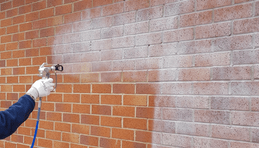
- Dries clear, preserving the original appearance of the substrate.
- Provides a super hydrophobic, self-cleaning surface (Lotus Effect).
- Highly breathable.
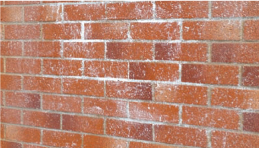
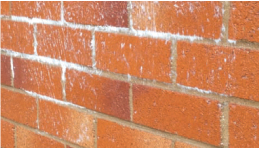
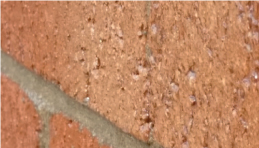
- Guards against salt efflorescence and sulphate attack.
- Prevents discoloration.
- Deters moss, algae, and lichen growth.
- Shields against frost damage.
- Proven performance.
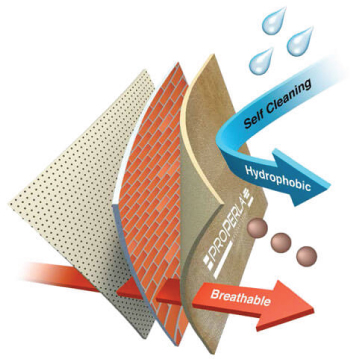
Breathable
Ecoshieldcoating Masonry Crème allows the building to breathe freely. Water vapor permeability testing, following BS EN ISO 7783:2011, showed minimal impact on the substrate’s water vapor diffusion.
The application of our masonry cream ensures dry walls and cavities while enabling air and moisture to escape. It preserves the building envelope’s ability to breathe, unlike certain stone and brick sealers that form a thin film, blocking masonry pores. This highly breathable coating effectively prevents penetrating dampness.
A Clear Insulation Barrier
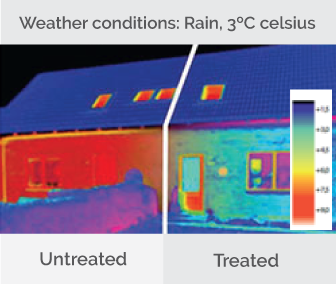
UKAS accredited tests confirm its ability to reduce water absorption, leading to improved thermal performance. It meets EAD 040083-00-0404 standards.
Hygrothermal chamber testing revealed that walls coated with the cream, subjected to heat-rain conditions (EAD 090062-00-0404), had reduced heat loss compared to uncoated walls. The uncoated wall showed an average increase of 6⁰C in heat loss compared to the coated walls.
Superior Masonry Protection and Insulation Solutions
Super Hydrophobic Coating
A surface becomes super hydrophobic when water droplets bead up with a contact angle exceeding 140⁰ and can easily slide away (low contact angle hysteresis). Such surfaces repel water, causing it to form beads due to its higher attraction to itself than the surface. This phenomenon, known as the ‘lotus effect,’ is also observed on duck feathers and butterfly wings.
Substrates coated with the protective masonry cream exhibit similar behavior, forming water droplets that do not penetrate the surface. Independent testing confirms it reduces water absorption by 96.3% and meets the British standard for water vapor resistance BS EN ISO 7783:2011.